More than 10 workstations · support contract · remote, on-site and phone support
02 · Cybersecurity policies
Why does a "compliant" employee open the door to an attack?
Because they did what seemed normal. They used their email password on the courier's portal. They plugged in a USB stick from home. They lent their password to the intern "just for today". Without a written rule, none of this is forbidden. A policy is not a…
03Each fits on half a page, signed by everyone and reviewed once a year.
04DataRoad provides the templates and checks technical compliance in the monthly report.
In this article
A reused password or a "invoice" opened by mistake can cost weeks of operation. In most SMEs, that mistake is not even anyone's fault: the company simply never wrote the rules down. Cybersecurity policies fix that with seven short sheets, one per topic, that the whole team reads and signs. They are the foundation of the managed cybersecurity DataRoad - IT Services and Consulting implements for its clients.
Why does a "compliant" employee open the door to an attack?
Because they did what seemed normal. They used their email password on the courier's portal. They plugged in a USB stick from home. They lent their password to the intern "just for today". Without a written rule, none of this is forbidden. A policy is not a legal document: it is half a page on what to do and what not to do.
Which seven cybersecurity policies should you have in writing?
#
Topic
Answers
1
Accounts and MFA
How do we protect every login?
2
Devices
Which equipment may touch the data?
3
Email
What do we do with a suspicious message?
4
Permissions
Who can see what?
5
Backups
Can we recover?
6
Incidents
Who does what on the worst day?
7
Joiners and leavers
Which access do we open and close?
1. How are accounts protected?
Phrases, not codes 14 characters or more, instead of short words full of symbols.
One credential per service Stored in the company password manager; never sent by email or chat.
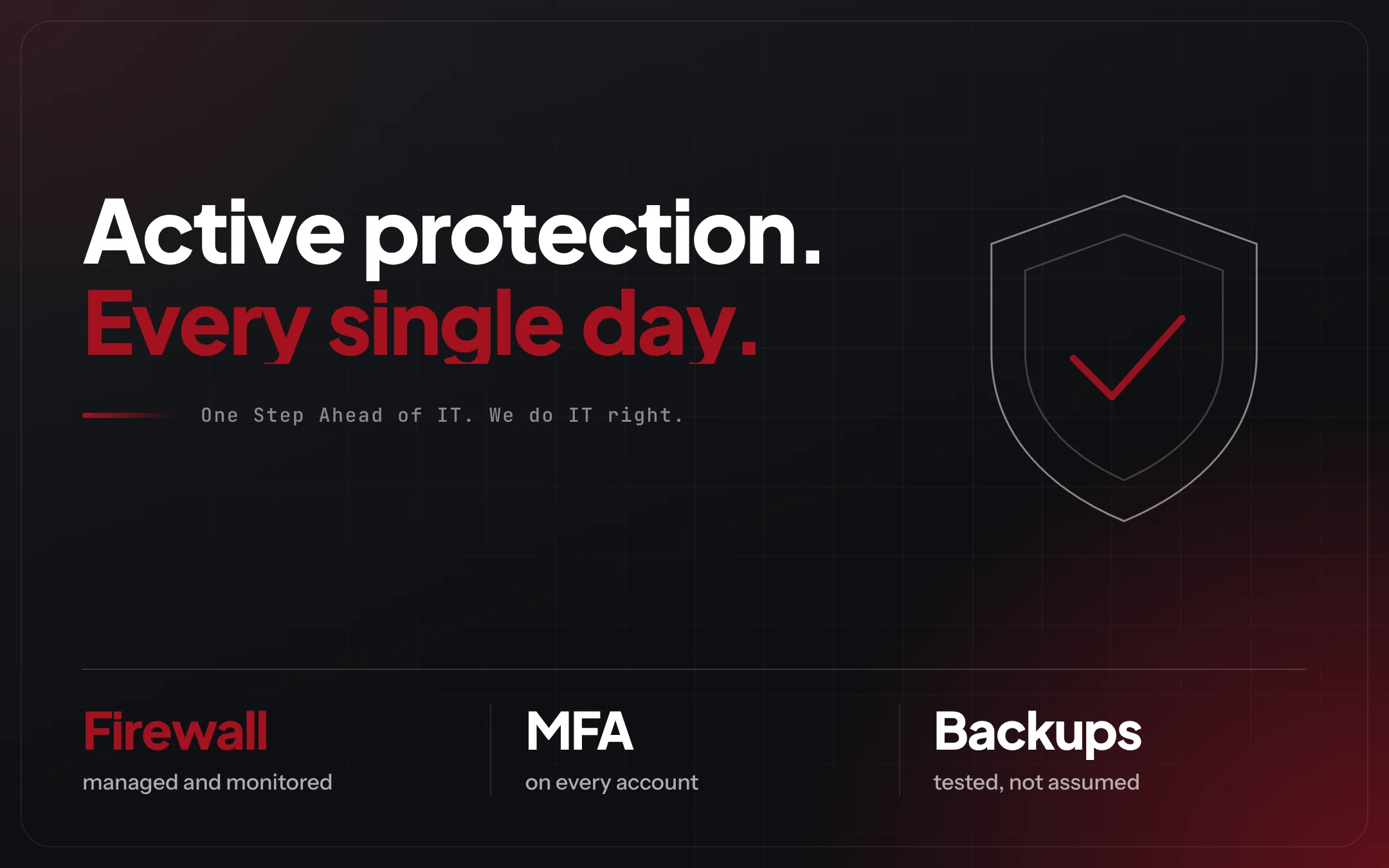
MFA without exceptions Email, files and remote access. Management too: it is the favourite target.
Shared accounts A new credential whenever someone leaves the company.
Company devices, with active protection, automatic updates and an encrypted disk. Personal devices only through the browser, without saving files locally. A laptop never spends the night in the car. If it goes missing, report it the same day and access is blocked remotely. Software only from the approved list, which must exist.
3. What should you do with a suspicious email?
Do not click, do not reply, forward it to IT. A supplier's change of IBAN is always confirmed by phone, to a number you already had, never the one in the email. That is what stops the altered-IBAN invoice fraud. Client data never travels via personal email or messaging apps.
4. Who can see what?
Least necessary Everyone accesses what their role requires, nothing more.
Review every six months Shared folders and SharePoint.
Local admin rights IT team only.
Third parties Named access, with an expiry date and logging.
Change of role The old access is removed; the new one is not simply added on top.
5. If everything were encrypted tomorrow, could you recover?
Only with a policy stating what is copied, how often, where to and for how many days it is kept. At least one copy off-site and immutable: ransomware cannot delete it. Restores tested on set dates, with the result recorded. Someone responsible for failure alerts, with a deadline to act. Find out how our managed backup works and what a disaster recovery plan adds.
6. Who does what on the day of an attack?
Alert chain: who calls whom, and in what order.
Isolation: the affected workstation comes off the network; the whole server does not.
Spokesperson: one person talks to clients and suppliers; the others do not.
Legal deadlines: the CNPD (Portuguese data protection authority) within 72 hours if personal data is involved; the National Cybersecurity Centre if the company falls under NIS2.
Printed contacts: IT partner and insurer, because email may be down.
7. Which access is opened and closed with each person?
On day one: an account with the role's permissions, MFA switched on, equipment handed over and logged, and half an hour on these rules. On the last day: account disabled that day, not a week later; email forwarded; equipment returned and checked; shared credentials changed; third-party access linked to that person cut off. Former employees' accounts still active are among the most frequent failures in our audits.
How do you move from paper to practice in a few weeks?
Half a page per policy. Start with what you already do well, add what is missing and cut unrealistic bans: a rule nobody follows discredits the rest. Management approval, a short session with the team, everyone's signature, an annual review.
In our managed cybersecurity contracts we deliver these seven templates tailored to each client and confirm technical compliance in the monthly report: MFA on, accounts disabled, backups tested. In 11 years, DataRoad has never suffered a security incident.
Questions from decision-makers
With 12 people, is it worth writing policies?
Yes: they are the same seven, just shorter. Risk does not shrink with size, and in a small team a forgotten account of someone who left weighs even more.
Are we covered for GDPR and NIS2?
Partly. These policies form part of the required technical and organisational measures, but they do not replace the record of processing activities (GDPR) or the risk analysis (NIS2): they provide the foundation for them.
Who has to sign?
Everyone with access to systems: management, interns and temporary staff included. Without a signature, there is no way to enforce them.
How often are they reviewed?
Once a year, and whenever something relevant changes: a new ERP, wider remote working, an incident or new legislation.
Next step: the seven policies, adapted to your company
We give you the templates, adapt them to your company and configure the technical side (MFA, permissions, backups) so that what is written is what actually happens. See DataRoad managed cybersecurity and request a no-commitment proposal.
More than 10 workstations · support contract · remote, on-site and phone support.