Managed cybersecurity for SMEs: 9 defences and the right order
Attackers do not go after large companies: they go after SMEs, because they have fewer defences. Nine protections and the right order to put them in place.
How do I stop an attack before it reaches the internal network?
With a well-configured firewall: it is the first barrier between the inside and the internet. When there are several departments or types of device, splitting the network into VLANs contains the damage from a compromised device and stops an isolated case…
You only know if you test them. Having backups and having recoverable backups are different things, and many companies discover a corrupted or incomplete copy at the worst possible moment. Good practice follows the 3-2-1 rule (three copies, two different…
01Attacks target SMEs above all, because on average they have fewer defences.
02Priorities: firewall with VLANs, tested immutable backups, MFA and managed updates.
03Most incidents come in by email: training people is essential.
04Start with an audit that ranks the gaps by risk.
In this article
Attackers are not looking for large corporations: they are looking for SMEs, because on average they have fewer defences in place. For a Portuguese company, a single incident can mean days of downtime, lost data and clients who need explanations. This managed cybersecurity checklist brings together the nine protections every SME should have active, whatever its sector, and tells you where to start.
The five you cannot do without today
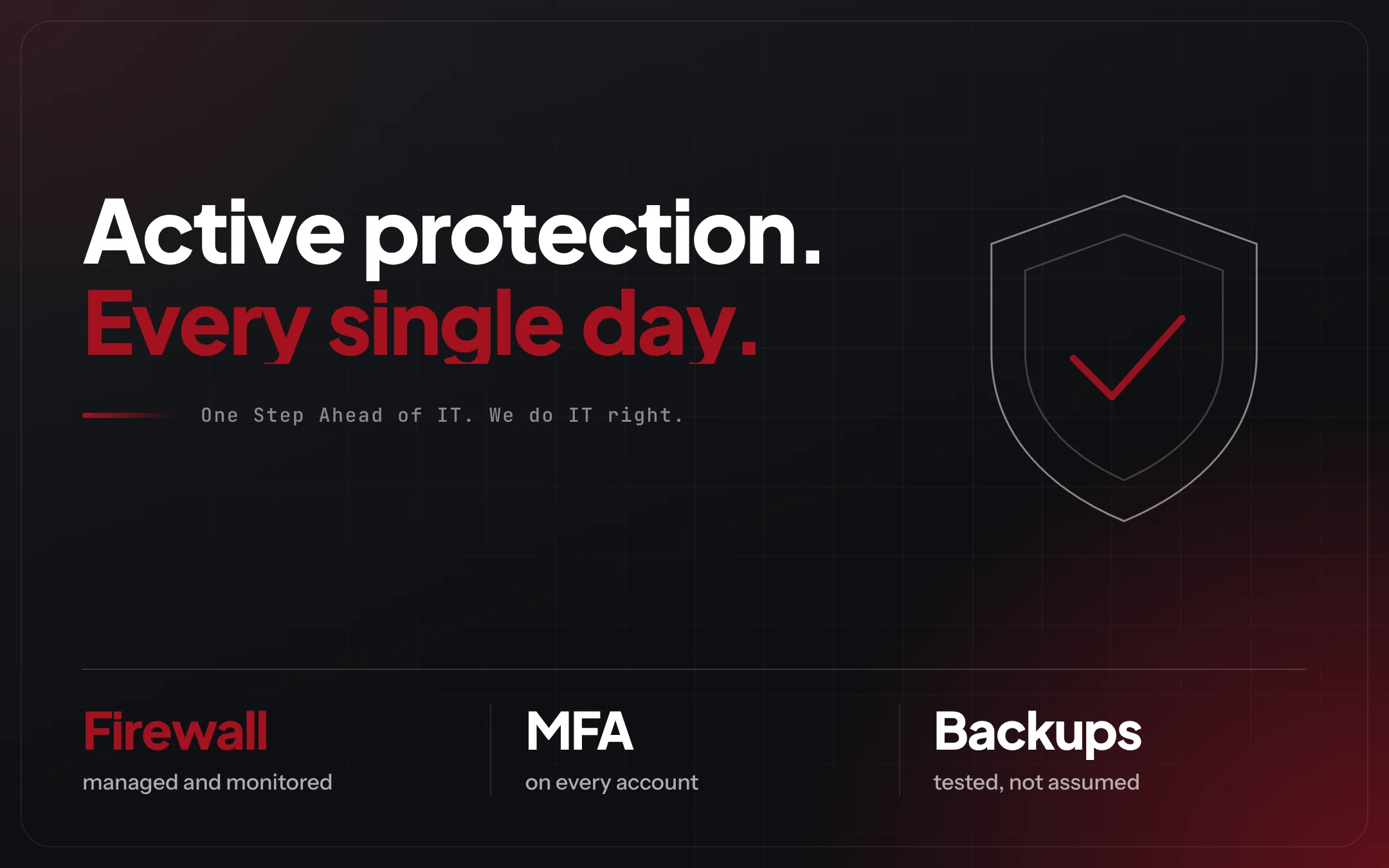
A dedicated firewall with VLANs Critical systems, workstations and guests on separate segments.
Backups with proof of restore And at least one offline or immutable copy.
MFA On email and on any remote access.
Centralised updates Never left to each user's discretion.
Trained people Because email is how most incidents get in.
How do I stop an attack before it reaches the internal network?
With a well-configured firewall: it is the first barrier between the inside and the internet. When there are several departments or types of device, splitting the network into VLANs contains the damage from a compromised device and stops an isolated case spreading across the entire infrastructure.
Remember: the usual target in Portugal is not the large organisation. It is the smaller company, precisely because of its lack of defences.
Do my backups really work?
You only know if you test them. Having backups and having recoverable backups are different things, and many companies discover a corrupted or incomplete copy at the worst possible moment. Good practice follows the 3-2-1 rule (three copies, two different media, one off site) with periodic test restores, not just a message saying the job "completed without errors".
Is a stolen password enough to get in?
Not with MFA. With a second factor active, the password alone no longer opens email, files or critical applications. Few security measures cost so little for the effect they have. It should be active on corporate email, the VPN and management applications.
Who makes sure every workstation is up to date?
It has to be a central process, not each employee. Outdated operating systems, ERP and network equipment firmware are among the most exploited entry points. Centralised patch management delivers fixes to every workstation uniformly.
Can employees recognise phishing?
This is where almost every incident starts: a click on a fake link, a shared password, an attachment opened without checking. Regular awareness sessions, even short ones, reduce this risk significantly.
Does each person have only the access they need?
They should. The principle of least privilege gives each employee access only to the systems and data of their role. It reduces the impact of a compromised account and makes it auditable who sees what. Active Directory or an equivalent directory is the most effective way to apply it.
How do remote teams get in?
Always through an encrypted VPN. With hybrid working, any access to systems from outside must go through a protected tunnel, never through ports opened directly onto the internal network.
Would I see an attack starting?
Only with monitoring. An attack is rarely instantaneous: before the impact there are repeated login attempts, unusual traffic, unauthorised changes. A NOC with 24/7 monitoring, exclusive to the Premium 365 plan, detects these signs and reacts before they become a serious incident.
Do I know what to do in the first hour of an incident?
It should be written down before it happens: who to contact, which systems to isolate first, how to communicate inside the company. A response plan greatly shortens reaction time and, with it, the damage.
I have few of these defences. Where do I start?
Do not try everything at once. Start with an infrastructure audit that identifies the most critical gaps and ranks the fixes by their impact on risk. See our managed firewalls, VPN and network protection, with continuous monitoring on Premium 365.
Who is DataRoad?
A premium Portuguese MSP, headquartered in Alfragide with support across the whole country. Since 2015 it has safeguarded the infrastructure of companies that cannot stop (hotels, clinics, embassies, universities, multinationals and demanding SMEs) with a certified team, and monitoring and 24/7 support on the Premium 365 plan. In 11 years, DataRoad has never suffered a security incident.
IT Unlimited Fixed fee, unlimited requests, remote and on site depending on the plan.
Structured cabling Design, installation and certification, Layer 3 switching and PoE.