
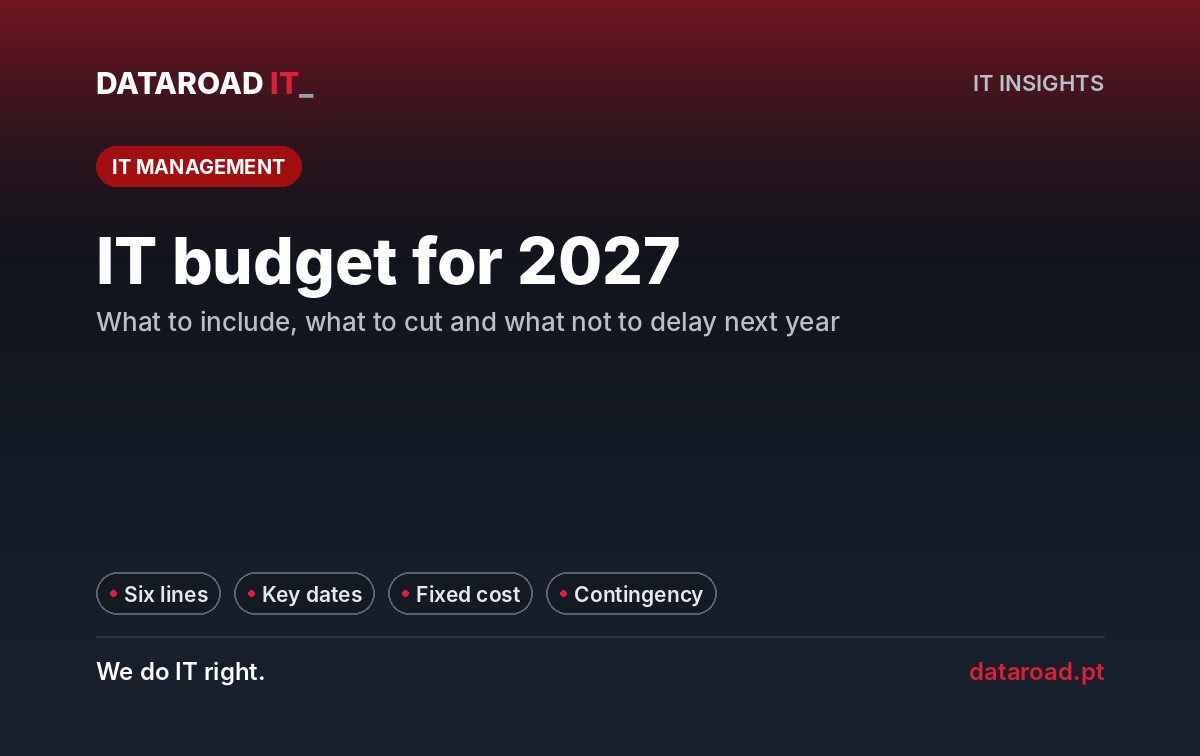
IT budget for 2027September and October are the months when most SMEs close the budget for the following year, and IT usually comes as a single line — “IT: same as last year plus 5%”. Then comes March, a server dies, a license changes price, and the line explodes. This article proposes a more useful way to budget for IT for 2027: six categories, three dates that force spending, and a decision about what should be fixed costs and what should be investment.
The six headings of an IT budget
- Support and managementwho keeps the IT running — internal team, external supplier or both. Includes monitoring, helpdesk and maintenance.
- Licensing and subscriptionsMicrosoft 365, management software, antivirus, backup, per-user tools. It tends to grow without anyone noticing.
- User equipmentlaptops, workstations, monitors, mobile phones. Costed per renewal cycle, not per fault.
- Infrastructureservers, storage, network, Wi-Fi, firewall, UPS. Longer cycles, higher values, decisions that are planned a year in advance.
- Security and continuityendpoint protection, managed firewall, off-site backups, recovery plan. Increasingly non-negotiable — NIS2 and insurance policies demand it.
- Communications: Internet (ideally two connections), telephony, connections between offices.
If your current budget does not distinguish these six lines, start by separating them using the 2026 values. It is half a day's work and it is what allows you to decide anything.
Three dates that force expenditure in 2027
- Windows 10 out of support since October 2025. Stations that have not yet migrated are accumulating risk. If they are left until 2027, the user equipment budget must reflect the replacements — see what to do about the end of Windows 10 support.
- Windows Server 2016 out of support in January 2027. Servers in this version have to be replaced, virtualised or migrated during the year. The decision is explained on the about page servers and virtualisation.
- NIS2 in force. For the covered entities, and for many of their suppliers, 2027 is the year by which the measures must be demonstrable. See if your company is covered.
What to pass to fixed cost
Computing has two natures: the one you buy (hardware, projects) and the one you pay for every month (support, licences, security, communications). The common mistake is to treat support like the first — paying by the hour when something breaks — which makes the budget unpredictable and, worse, creates an incentive not to call anyone while things are “ticking along”. A support contract with a fixed monthly fee and a written SLA does the opposite: the cost is known in January and the supplier has an interest in prevention. We compared the models in IT Unlimited vs. retainer, block of hours and outsourcing and we explained how much does IT support for a company cost.
What to cut without risk
- Licences allocated to accounts belonging to people who have left the company, or Microsoft 365 plans that exceed what each role actually uses. In a company with 50 workstations, it is common to find between 10 and 15% excess licences.
- Duplicate subscriptions: two antivirus products, two meetings tools, three cloud storage tools.
- Maintenance of end-of-life equipment. Repairing a 7-year-old laptop costs more than writing off a new one.
- Old communications contracts. Debts and prices have changed; a request for a review from the provider usually pays off.
What not to postpone
Off-site and tested backups; multi-factor authentication; actively managed firewall; replacement of unsupported systems. These are the four points which, when they fail, bring the company to a halt or expose it to a fine — and none of them are expensive relative to the damage. If the budget only stretches to one thing in security, it is the first on the list: a company with tested backups survives almost everything else.
A rainy-day fund
Even if everything is planned, set aside 10% of the total for the unforeseen: a piece of equipment that breaks down prematurely, a change in the law, or unexpected growth. If, at the end of the year, the reserve has not been used, it can fund the next renewal. If there is no reserve, the unforeseen costs will be covered by another budget line — usually safety, which is the one you notice least when funds are short.
How to request comparable proposals
When asking for support proposals for 2027, ask everyone for the same thing: number of stations and servers, what is included (call-out travel? out of hours? projects?), written response times by priority, what happens when the contract ends. Without this, you are comparing monthly fees that do not cover the same thing. Our article on what to include in an IT contract It has the complete list.
Frequently Asked Questions
How much should an SME spend on IT?
It depends on the sector and the systems involved, but for service companies with between 10 and 100 staff, the usual benchmark ranges from 3% to 6% of turnover, including staff, licences and equipment. More useful than the percentage is knowing where the money goes — hence the six categories.
Is it better to buy equipment or hire it?
Buying gives control and works out cheaper after 4-5 years; renting turns everything into a monthly cost and simplifies renewal. For workstations both work; for servers, the right question is whether you still need one.
Should the support be internal or external?
Below 100 stations, a full-time internal technician rarely pays off and creates a single point of failure (holidays, leaving). Many companies combine an external contract with an SLA and an internal relationship manager. We compared the two in internal IT support or outsourcing.
When should I start budgeting?
September and October, with the updated inventory. Equipment renewals and server replacements require delivery times and migration windows that are planned months in advance.
Want an IT quote with real figures for your company?
We carry out an inventory of the hardware and licences, identify what expires in 2027 and deliver a plan with fixed costs and separate investments. See the IT Unlimited ou ligue +351 211 459 950.
DataRoad projects and success stories
IT Unlimited Essential
Desde 395 €por mês (+ IVA), para 10 postos
- Includes unlimited helpdesk, PC management, monitoring, patch management, and remote support
- Remote and telephone support only
no travel included - Ticketing support
with orders portal - Incident response with an SLA
- Update management
and security patches - Monthly activity report
- Helpdesk during working hours
by email and telephone - The price may increase with the number of stations, the size of the network, servers, websites, printers, NAS devices, critical systems, and Apple equipment.
IT Unlimited Premium
Desde 750 €por mês (+ IVA)
- Includes unlimited helpdesk, Microsoft 365 management, PC management, antivirus/EDR, monitoring, patch management, and remote support
- Unlimited in-person support
- With travel included
- Monitoring and alarm systems
- Complete IT infrastructure management
- Cybersecurity included
managed firewall and antivirus - Priority SLA
immediate response to critical incidents - No limit on hours
- Dedicated helpdesk
with priority in the queue - The price may increase with the size of the park and the network, servers, websites, printers and NAS, critical systems, and Apple equipment.
IT Unlimited Premium 365
Desde 1.200 €por mês (+ IVA)
- Includes unlimited helpdesk, Microsoft 365 management, PC management, antivirus/EDR, monitoring, patch management, and remote support
- Everything that’s included
no IT Unlimited Premium - 24 hours a day, 7 days a week, 365 days a year support
- Out-of-hours support: evenings,
weekends and bank holidays - Dedicated technical account manager
- Regular IT strategic alignment meetings
- Business Continuity Plan (Disaster Recovery)
- Priority access to network and infrastructure projects
- Customised executive reports
- The price may increase with the size of the park and the network, servers, websites, printers and NAS, critical systems, Apple equipment and off-hours coverage
Don't know which one to choose? Talk to us and receive a fixed-price quote · Como se calcula o preço
At DataRoad, technology is a passion. We really love what we do, and that shows in every network we install, in every problem we solve, and in every company we support.
















































![mun[it] logo, a digital marketing agency — a DataRoad client](https://www.dataroad.pt/wp-content/uploads/2026/09/logo-cliente-munit.png)