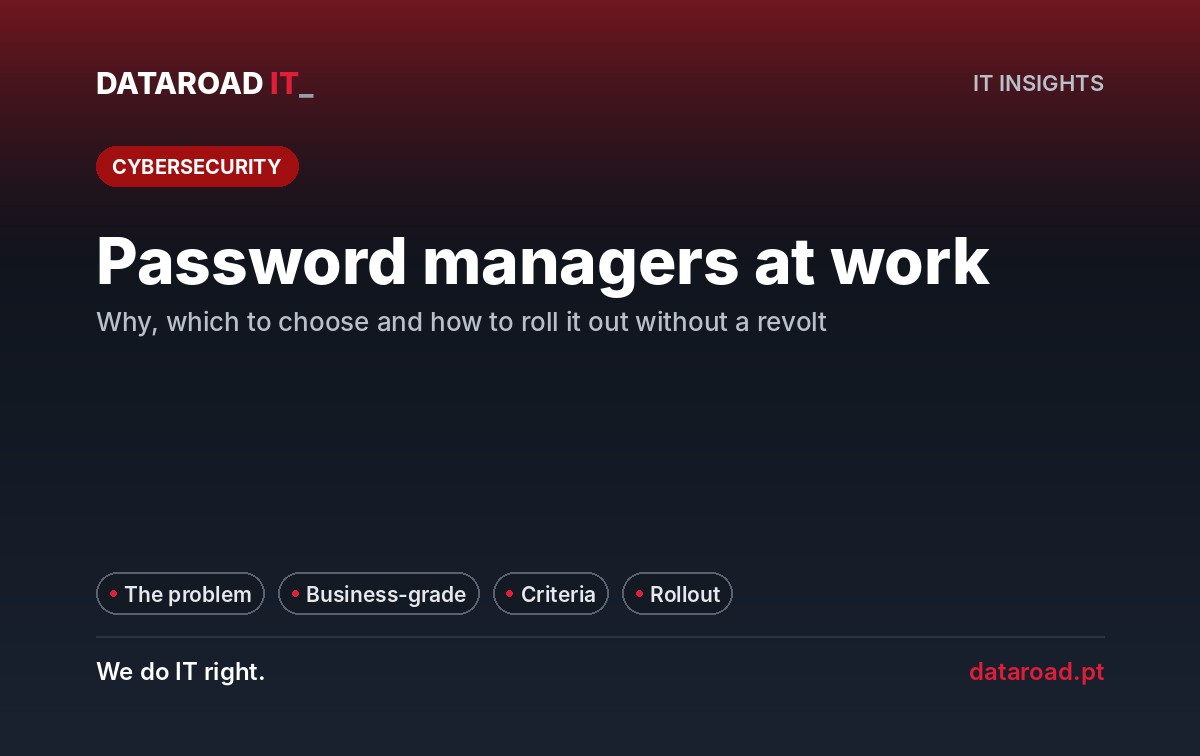
Password manager in the companyAsk any person in your company how many different passwords they use. The honest answer is “two or three, with variations.” The email password is similar to the one for the management software, which is identical to the one for the personal online shopping account that was stolen in a data breach two years ago and is for sale. This is how most attacks on SMEs start: not with a computer genius, but with a reused password. A password manager solves this problem at its root — and it is one of the few security measures that, when well implemented, make people’s lives easier, not more difficult.
The problem it solves
An average person in a company needs 30 to 80 different credentials: email, management software, supplier portals, banks, online tools, Wi-Fi, printers, corporate social media. No one can memorise 80 long and different passwords. That is why they reuse them, or write them down in an Excel file called “passwords.xlsx”, or on a sticky note. A password manager stores them all encrypted, generates long, unique passwords for each service, auto-fills them and syncs them between the computer and the mobile phone. The person only has to remember one – the master password – and uses multi-factor authentication to protect it.
What a business manager does beyond what a personal manager does
- Shared safesthe password for the Finance portal, the advertising account or the router goes in a team safe, not in someone's head. When that person leaves, the company doesn't lose access.
- Head officethe company creates and removes users, sets policies (minimum length, mandatory MFA) and recovers vaults when someone leaves or forgets the master password.
- Access logwho accessed which credential and when. Essential for auditing and for NIS2.
- Alertspasswords that are broken, reused, or have appeared in known data breaches.
- Microsoft 365 integrationPeople log into the manager with the company account; deactivating the account deactivates the manager.
Criteria for choosing
End-to-end encryption (the provider cannot read your passwords, even if they want to); mandatory multi-factor authentication; shared vaults with group-based permissions; browser extension and mobile apps; administration and recovery capabilities; exportable activity log; headquarters and servers in the European Union or equivalent GDPR guarantees; and predictable per-user pricing. Well-established enterprise products on the market tick almost all of these boxes — the difference lies in usability, which is what determines whether people will actually use it. Avoid solutions that store passwords in a shared file, no matter how encrypted it may be: they lack auditing, have no recovery, and do not scale.
Implement within three weeks
- Week 1 — Prepare. Choose the product, set up the organisation, link it to Microsoft 365, define the policy (mandatory MFA, minimum length 14). Create shared vaults by department and migrate there the company passwords that currently live in files and post-its. Identify the admin credentials (firewall, switches, servers, domains) and place them in a vault restricted to IT.
- Week 2 — Pilot. Five to ten people from different departments, including someone from management. Twenty-minute session, installation of the extension and app, importing passwords saved in the browser. Gather what went wrong.
- Week 3 — All. 20-minute sessions per group, with the clear rule: as of today, new passwords are generated by the manager, and reused ones are changed as they are used. Don't force everyone to change everything on the first day — that's what causes a revolt.
The errors that cause failure
Import without explaining (people work around what they don't understand); not migrating browser passwords (the user ends up with two sources and gives up); not having shared vaults (the team keeps exchanging passwords by email); forgetting the mobile phone (half of all access nowadays is mobile); and not disabling the browser's autofill, which competes with the manager and is much less secure.
What changes after three months
Unique and long passwords on all new services, and most of the old ones. Nobody knows anyone else's password — nor do they need to. An employee leaving is no longer a risk: you disable the account and the shared vaults remain with the company. Password reset requests to support drop dramatically. And the company now has a concrete answer to the NIS2 and insurance question: “how do you manage credentials?”.
Where does it fit in with the other measurements
The password manager is the second identity measure, after the multi-factor authenticationMFA protects the account even if the password is stolen; the manager ensures the password is neither reused nor weak. Together, they are step 1 of Zero Trust for SMEs and the password policy base of the seven internal cybersecurity policies. In our contracts managed cybersecurity The implementation of the manager and the management of the administration safes are part of the service.
Frequently Asked Questions
What if the manager's supplier is attacked?
With end-to-end encryption, the provider stores encrypted vaults that only the user's master password can open. A breach exposes unreadable files. That is why the master password has to be long and MFA mandatory.
Isn't the browser manager (Chrome, Edge) enough?
For personal use it is better than nothing. For a company, it has no shared vaults, administration, logging or recovery, and you are tied to a browser and a personal account.
What if someone forgets their master password?
Business managers have administrative recovery: a designated administrator can restore access to the person's vault. It is one of the reasons to use a business product rather than a personal one.
How much is it?
Enterprise products typically cost a few euros per user per month. Compare that with the cost of a single stolen credentials incident or of losing access to the tax authority portal because the person who had the password left.
Do you want to implement a password manager without a fuss?
We choose the product with you, configure the organisation and vaults, and hold the sessions with the team. Have a look at our managed cybersecurity for businesses ou ligue +351 211 459 950.
DataRoad related services: Microsoft 365 for business · IT Unlimited Computer Management
DataRoad projects and success stories
IT Unlimited Essential
Desde 395 €por mês (+ IVA), para 10 postos
- Includes unlimited helpdesk, PC management, monitoring, patch management, and remote support
- Remote and telephone support only
no travel included - Ticketing support
with orders portal - Incident response with an SLA
- Update management
and security patches - Monthly activity report
- Helpdesk during working hours
by email and telephone - The price may increase with the number of stations, the size of the network, servers, websites, printers, NAS devices, critical systems, and Apple equipment.
IT Unlimited Premium
Desde 750 €por mês (+ IVA)
- Includes unlimited helpdesk, Microsoft 365 management, PC management, antivirus/EDR, monitoring, patch management, and remote support
- Unlimited in-person support
- With travel included
- Monitoring and alarm systems
- Complete IT infrastructure management
- Cybersecurity included
managed firewall and antivirus - Priority SLA
immediate response to critical incidents - No limit on hours
- Dedicated helpdesk
with priority in the queue - The price may increase with the size of the park and the network, servers, websites, printers and NAS, critical systems, and Apple equipment.
IT Unlimited Premium 365
Desde 1.200 €por mês (+ IVA)
- Includes unlimited helpdesk, Microsoft 365 management, PC management, antivirus/EDR, monitoring, patch management, and remote support
- Everything that’s included
no IT Unlimited Premium - 24 hours a day, 7 days a week, 365 days a year support
- Out-of-hours support: evenings,
weekends and bank holidays - Dedicated technical account manager
- Regular IT strategic alignment meetings
- Business Continuity Plan (Disaster Recovery)
- Priority access to network and infrastructure projects
- Customised executive reports
- The price may increase with the size of the park and the network, servers, websites, printers and NAS, critical systems, Apple equipment and off-hours coverage
Don't know which one to choose? Talk to us and receive a fixed-price quote · Como se calcula o preço
At DataRoad, technology is a passion. We really love what we do, and that shows in every network we install, in every problem we solve, and in every company we support.
















































![mun[it] logo, a digital marketing agency — a DataRoad client](https://www.dataroad.pt/wp-content/uploads/2026/09/logo-cliente-munit.png)